
Playing Around (TV Mini Series, Season 1, 2026)
Original Spanish Title: “Soy Germán Andrés Yanex (G.A.Y)”
Directed by James Camargo De Alba
Screenwriters: James Camargo De Alba and Deimer Vergara Torres
Cinephobia Releasing, streaming on Amazon Prime and Vimeo
Season one of the Spanish-language Playing Around is the most thoroughly enchanting miniseries to come my way, at once outrageously hilarious and deeply poignant. There is so very much to like about Playing Around, particularly the extraordinary flair and sense of whimsy which James Camargo De Alba brings to the entire production. In Colombia, the twenty-nine-year-old protagonist, Germán (portrayed by the series creator James Camergo De Alba), is desperately seeking a lasting relationship before he hits thirty. He goes about it the modern way: using meet-up sites, with mixed results. He appears to be hitting it off with various successive candidates, each of which must be “the one”, only to find they lack the ability or desire to go the distance.
The series opens with Germán announcing to his mother, Gloria (played to perfection by Obeida Benavides), that he is gay. She is taken aback but really just wants her son to be happy. Gloria is the kind of wise and compassionate Mother everyone should have, and she shares her wisdom and vulnerabilities in a decidedly endearing manner. Prior to his straightforward declaration, he muses in fantasy sequences about how to broach the topic with her: he imagines being whisked down a hospital corridor on a gurney after a bloody accident. Might this be the best time to tell her? This first season series is full of these cinematic asides, always colorfully rendered, and I began looking forward to them. Throughout Playing Around, Germán also looks straight into the camera, punctuating the action with his face expressing his personal feelings about what’s going on. [These devices reminded me of Federico Fellini's use of fantasy in 8 ½, when the character Guido displays his vision of how he will respond to being hounded.] Gloria inquires about Germán's past interactions, and we are presented with a selection of his encounters. Early on, Angel is introduced: a fellow university student who has missed his bus, and Germán tells Mom he’s staying the night. We’ll be seeing a great deal more of Angel as the series proceeds. Germán certainly is making the effort. Later, Germán meets Daniel and Diego, who invite him to join them in a “thruple.” Both Daniel and Diego secretly go off alone with Germán, which ends with Diego attempting to strangle him in a violent, jealous rage. So much for the “thruple”! Germán is the kind of well-mannered young man who expects those with whom he engages to be as sincere and authentic as himself — and therefore experiences a great deal of letdown. But he still proceeds with his quest, filled with twists and turns that sustained my rapt attention through to the episode's conclusion.
A standard recap of the entire season will not sufficiently capture the high-toned atmosphere of this series, so I'm providing highlights to hopefully convey the spirit of Germán’s adventure.
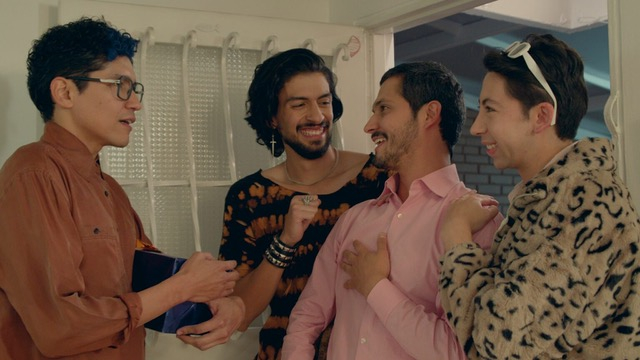
Near the middle of this first season, we experience a set piece. Germán works for a company that renders customer telephone support. He receives a letter inviting him to a photo session to create a calendar aimed at promoting the company’s diversity. An overly exuberant young manager arranged the photo session with various staff members who, in her mind, display diversity. There is Monica, who is Afro-Colombian, but (in the manager’s vision) she isn’t dark-skinned enough and gives her makeup to darken her complexion. Luis is a trans boy. Jorge has a hearing aid (in just one ear). Jenny uses a wheelchair — the bourand the manager tells her that she needs to look more pathetic and she halfheartedly complies. German, as a “gay” man, doesn’t look gay enough for her and costumes him in a preposterous feathery outfit with sparkly spectacles. She then plies the "diverse group" with strong drink, and a party with dancing ensues. Cut to: Germán waking up with a hangover in bed with Luis, wondering how he got there. They commence an affair. Germán frolics sweetly with Luis — but when Germán broaches becoming partners, Luis backs away, suddenly departing to walk his dog. Germán opens his phone to find that Luis has unfriended him. Heartbreak!
Gloria suggests that Germán may receive useful guidance from a psychotherapist. He declines her suggestion in favor of a regimen of self-care: working out, Tai Chi, yoga, running, and affirmations spoken into a mirror — all undertaken with diligent (and often goofy) resolve. It doesn’t work. He falls back to being down-and-out depressed, and finally takes his mother’s suggestion for psychotherapy. He makes an appointment at a clinic, not knowing which therapist he will be assigned. Unbeknownst they assign him to Angel. Angel says he might not be the right person to help Germán, but he has a friend who is a holistic therapist who channels angels and aligns the chakras, who might be more appropriate (appropriate?). Regardless, they slowly settle into conversation, and later have a second session after which they part in a particularly warm and friendly manner. Might this interaction with Angel evolve into what Germán seeks?
Playing Around is beautifully crafted, full of soft, bright light everywhere, and glossy in the best sense of the word. The sets provide a lovely backdrop for the action, and the cinematographer, Mariano José García Sánchez, certainly knows how to position and move his camera in these gracious settings. The music, composed by Emiro Pérez, is delightfully airy, seamlessly melding with the action. James Camargo De Alba, as Germán, shows that he is a superb actor as well as director, and the entire supporting ensemble plays their roles with natural grace.
I greatly favor independent productions like Playing Around, because I sense there were no "suits" (the moneypeople killjoys of Hollywood) compromising James Camargo De Alba’s intentions. I truly look forward to subsequent seasons.