
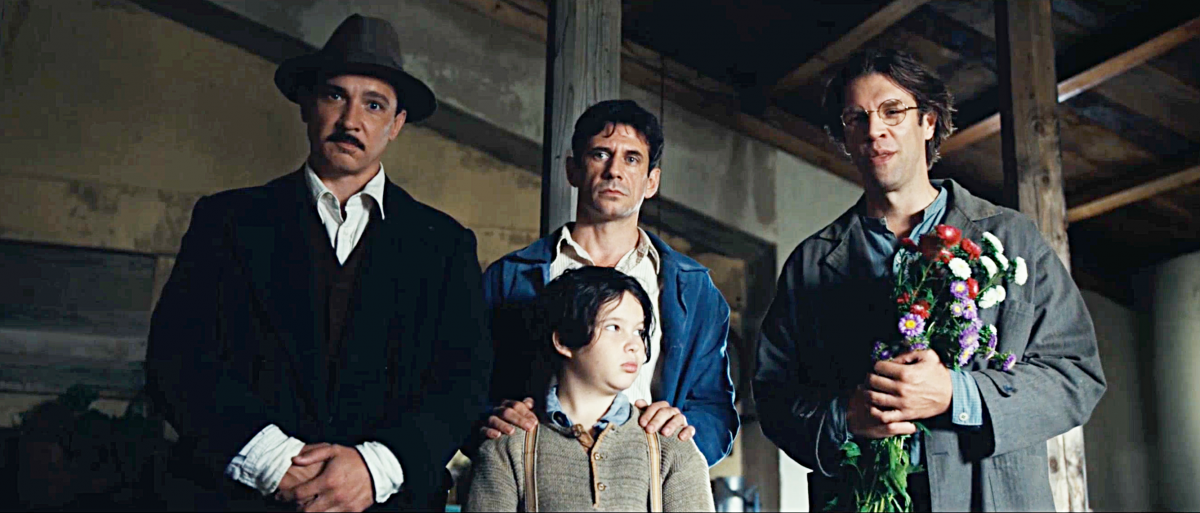
Palestine, 1928: lonely widower Moshe hires a woman, Yehudit, from a neighboring kibbutz to help raise his two children and work his farm. She arrives, surly and strong-willed, with few possessions and insists on sleeping in the stable, not the house. She is deaf in one ear and screams in the night.
Men are instantly smitten: Moshe (who considers her wife potential), the shrewd shopkeeper Globerman, and Jacob, a quiet intellectual who forsakes his marriage to the most beautiful woman in the town. The men circle her. Moshe teaches her the ways of the farm. Yaakov releases a cageful of wild canaries as a show of passion. Yehudit accepts them on her own terms, beds each, and soon is pregnant. She doesn’t care about paternity and isn’t about to marry anybody. Her child will have three fathers.
This story is the core of the film For the Love of a Woman. It has the contours of a folktale with hints of magical realism.
The film adds another flourish. For the Love of a Woman opens in the year 1978, focusing on Esther, a writer and a woman who exemplifies the era’s feminism and free love. Esther is headstrong and independent, very much her own woman. Upon her mother’s death, she receives a letter from her mother and a mission: that she travels to Israel, armed only with an old photo of her as a child with her father, which is torn to omit a mysterious third person.
For the Love of a Woman toggles back and forth between 1928 and 1978. Esther arrives and enlists the aid of a quiet academic, Zayde, who takes her around and, in the process, tells Yehudit’s story as a parable.
The film, guided by Guido Chiesa’s intelligent direction, is enthralling and well-acted. Mili Avital is elegant and sexy as the modern woman Esther. She has an air of ruined aristocracy about her. She and Zayde (Ori Pfeffer) take on a friendship that grows convincingly as Esther gets closer to her mother’s truth. Ana Ularu exudes arch, formidable beauty as Yehudit; one can see how Alabn Ukaj (Moshe), Marc Rissmann (Yaakov), and Serhii Kysil (Globerman) would drop everything to be with her. Fine cinematography by Emanuele Pasquet uses a limited color palette for 1978 that complements the sunburnt authenticity of the 1928 scenes.
For the Love of a Woman is expertly made, so it’s surprising that some sequences, especially those set in 1978, appear disjointed. Esther doesn’t feature as a character at all in the source novel “The Loves of Judith” by Meir Shalev. The filmmakers have added her, and one wonders why: did they decide the 1928 tale (1930s in the book) was too quaint, or might not hold the interest of a modern audience? Regardless, the framing device is underdeveloped and stitched together in editing. Mr. Chiesa and his co-screenwriter Nicoletta Micheli bring the stories together in the climax and their solution, while clever, comes off as contrived and a little, well, creepy.
_____________________________
For the Love of a Woman. Directed by Guido Chiesa. 2025. From Panorama Films. An Italian production in English and subtitled Hebrew. In theaters. Runtime 117 minutes.