
Nansi T. Lent: A Thread of Longing
BAU Gallery, Beacon
Fifty years of work can look like a string of reinventions. In A Thread of Longing, Nansi T. Lent’s work across that span reads as a single gesture, repeated until it becomes a language. The roughly twenty works run from 1974 to the present. They follow a painter of figures, family, and world events as she becomes a maker of signs, much as Lee Krasner did, as shown in the Pollock/Krasner show at the Metropolitan. (A word to the wise, don’t miss either exhibition.)
The show began with a question. Lent says she mounted it to answer the one graduate school kept asking: “Why do you make art? What does your art mean? You better know.” She went back through her work “to see if there was an arc across it.” She thinks there is.
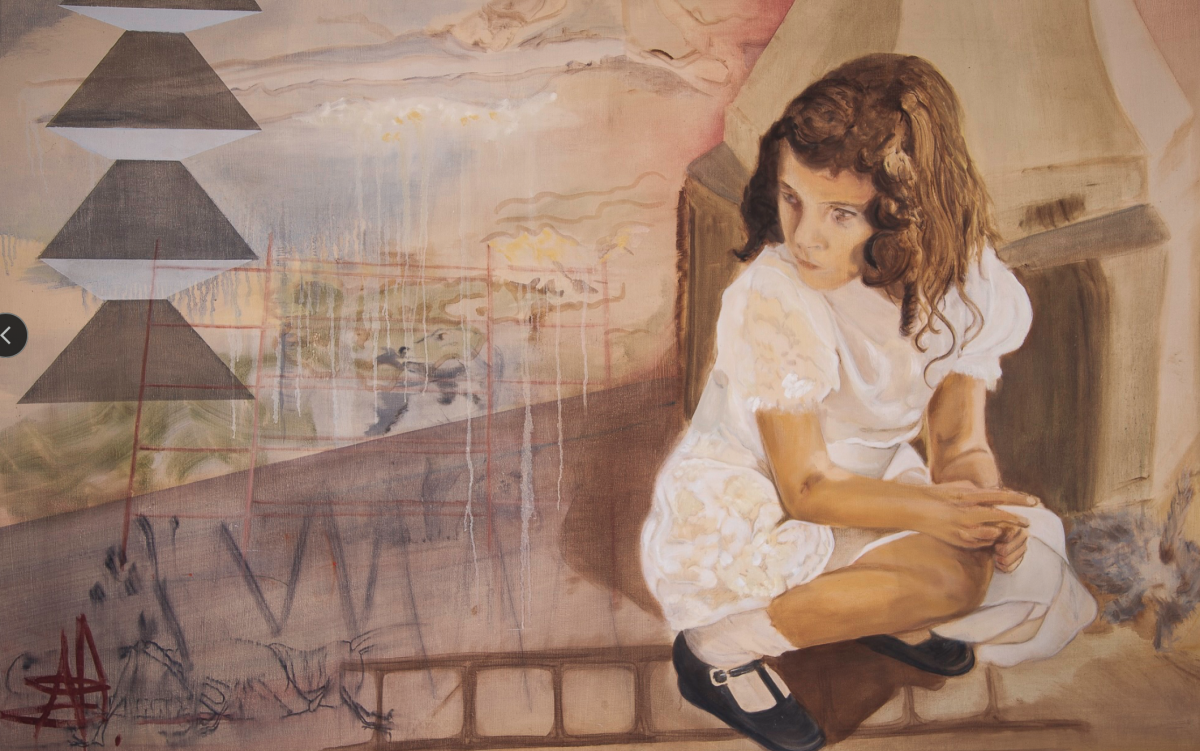
In Mary Janes (1980), (image below) a girl in a white dress crouches at the right edge of the canvas, arms around her knee, watching something out of frame. She is painted with weight and tenderness. Behind her, the picture comes apart into thin washes, a stack of dark trapezoids, drips, and charcoal scribbles. She is solid, and everything around her is provisional.
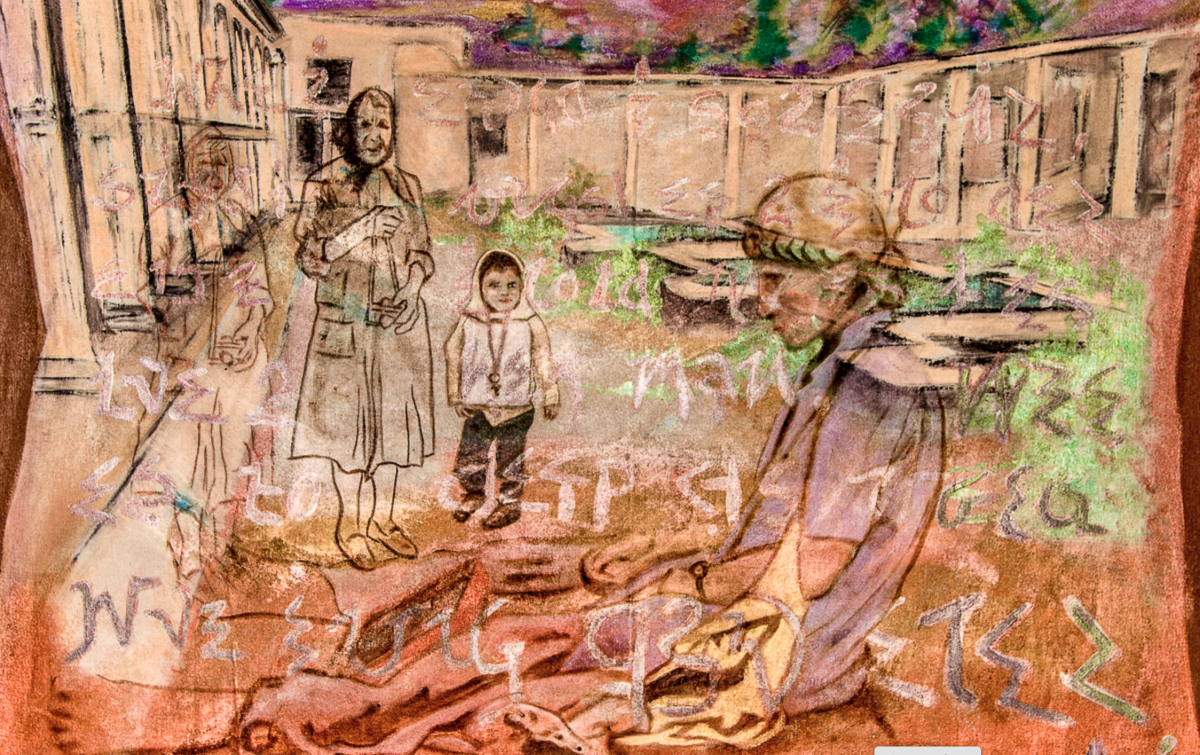
By Gypsy (1981), the provisional has taken over. In a sunlit courtyard, an older woman and a small hooded child stand watching, a ghostly third figure fades in at the left, and a hunched man fills the foreground. Pale script runs across all of them, loose, Greek-like and unreadable. The press materials place the beginning of Lent’s asemic writing here. The letters don’t replace the figures yet. They drift through them like speech with no one to receive it. Lent says the writing arrived before she had a name for it. “That was totally intuitive,” she says. “It was already happening, and I didn’t realize it.” Only in 2018, when she began “journaling in paint,” scratching white lines through wet color, did another artist tell her what she was doing was called asemic writing. Her handwriting has older roots. As a girl in Catholic school, she copied her homework into a chancery script with a fountain pen.
Taliban (2012, oil on canvas board, 20 x 16 in.) turns from private attachment to the news. A figure in white stands against a weathered ochre and rust wall, a cloth wrapped over the head and face so that only the eyes show, a rifle held across the body. A thin red line runs down the right edge, a second red shaft angles in from the left, and a black floor pools beneath the feet. Lent paints the figure with dark contour lines and leaves the face blank. Even here, in a picture drawn from the wider world, a person is present and unreadable. The paintings grew from her morning routine in Rhinebeck, where she sat with coffee and the papers while, in her words, “the world was falling apart.” Lent worked from newspaper photographs. She speaks of being overwhelmed by “why this life for me and another for someone else.” She tried to make icons of strangers, then to count the human race on a scroll. She gave up the count after five days. “We have to deal with what we’re dealt,” she says.
That quality has become the whole subject of Enigmatic Prayer (2023, charcoal, violet, mica and acrylic on canvas, 24 x 36 in.). The figures have gone. Pale lilac glyphs fill a dark aubergine field: a double spiral, a squared meander, a curled S, a star with a single dark eye. They are arranged like a tablet or a page of script. The surface is stained and slightly rough, and the canvas weave shows through. Nothing resolves into a word, though the shapes stay close enough to language to suggest meaning. The title does the rest. Lent calls such works sigils, images made to be viewed with an intention. “We live in a world where people curate their own spirituality,” she says, “so I feel these are very relevant.” Small “prayers” hang in the gallery window, each stamped on the back with a mantra.
That is the show’s quiet argument. Longing is not resolved from one decade to the next. It is held, and then it becomes a method. The girl’s watchfulness, the courtyard’s murmur, the masked figure’s closed face and the glyphs’ stubborn code are the same impulse at different distances from the human face. Lent explains why she keeps returning to counting and symbols. “All people are more alike than different,” she says, and she wants a language “that communicates beyond words.” Counting is the one she trusts most. “You can be blind and deaf and live in a jungle, and you’ll still know how to count your way to the water.” Lent, who is based in Rhinebeck and founded Womenswork.art in 2018, makes no promise that the prayer will be answered. She lets it keep going.
A Thread of Longing is on view at BAU Gallery, 506 Main Street, Beacon, through November 8, 2026. For further information, please contact BAU Gallery.