
Young-Ae Kwon: Against the Grain of Time
Asian & American Art Foundation, NYC
In reimagining the trajectory of abstraction, Korean-born artist Young-Ae Kwon, in The Aesthetics of Grain—her inaugural New York solo exhibition at the Asian & American Art Foundation—proposes a transformative form of abstract painting based on the monistic principle of gyeol (grain). The metaphysical gyeol is reinterpreted as material texture in Kwon’s works. Seon (aka Zen) philosophy, as seen in master Sahn Seung’s writings, channels non-dualism best expressed in his statement: “Their names and their forms are different, but their substance is the same.”
Ultimately, gyeol functions as the unifying substance that dissolves false dichotomies. By embedding handwoven ramie fiber—a craft historically gendered as domestic "women’s work"— within framed painterly fields of ottchil (traditional Korean lacquer) and gel stone, Kwon transcends the division between decorative handcraft and fine art. These polychromatic, vibrant surfaces, recalling the incandescent palette of Orphist experiments, transmute the intimate memories of labor into an elemental whole that speaks quietly of spiritual unity.
Rooted in childhood memories of her mother’s domestic labor and the pervasive presence of hemp in daily life, Kwon’s artistic practice translates these recollections into a meditative exploration of time. To construct her distinctive painterly surfaces, she meticulously adheres coarse hemp cloth to wooden panels before building up the ground with successive layers of gel stone, pigment, and ottchil. Developing slowly through patient, alternating cycles of controlled drying and natural curing, the works allow time itself to physically accumulate within the substrate. Rather than imposing ornamental complexity, this iterative process strips the surface down to its essential beauty.
Yet Kwon’s minimalism is infused with a vigorous intensity. Positioned in a territory between Gerhard Richter and Barnett Newman, her work rejects both the Epicurean, chance-driven randomness of Richter’s colors and the vast, overpowering monism of Newman’s monochromatic fields. Formally, Kwon operates against the grain of our times by refusing to succumb to the prevailing conceptualism of today’s contemporary art market. Instead, her practice remains uncompromisingly centered on color; not as an outburst of chaotic expressionism, or a monochrome infinity, but as an architectonic, almost cubistic configuration of the physical surface.
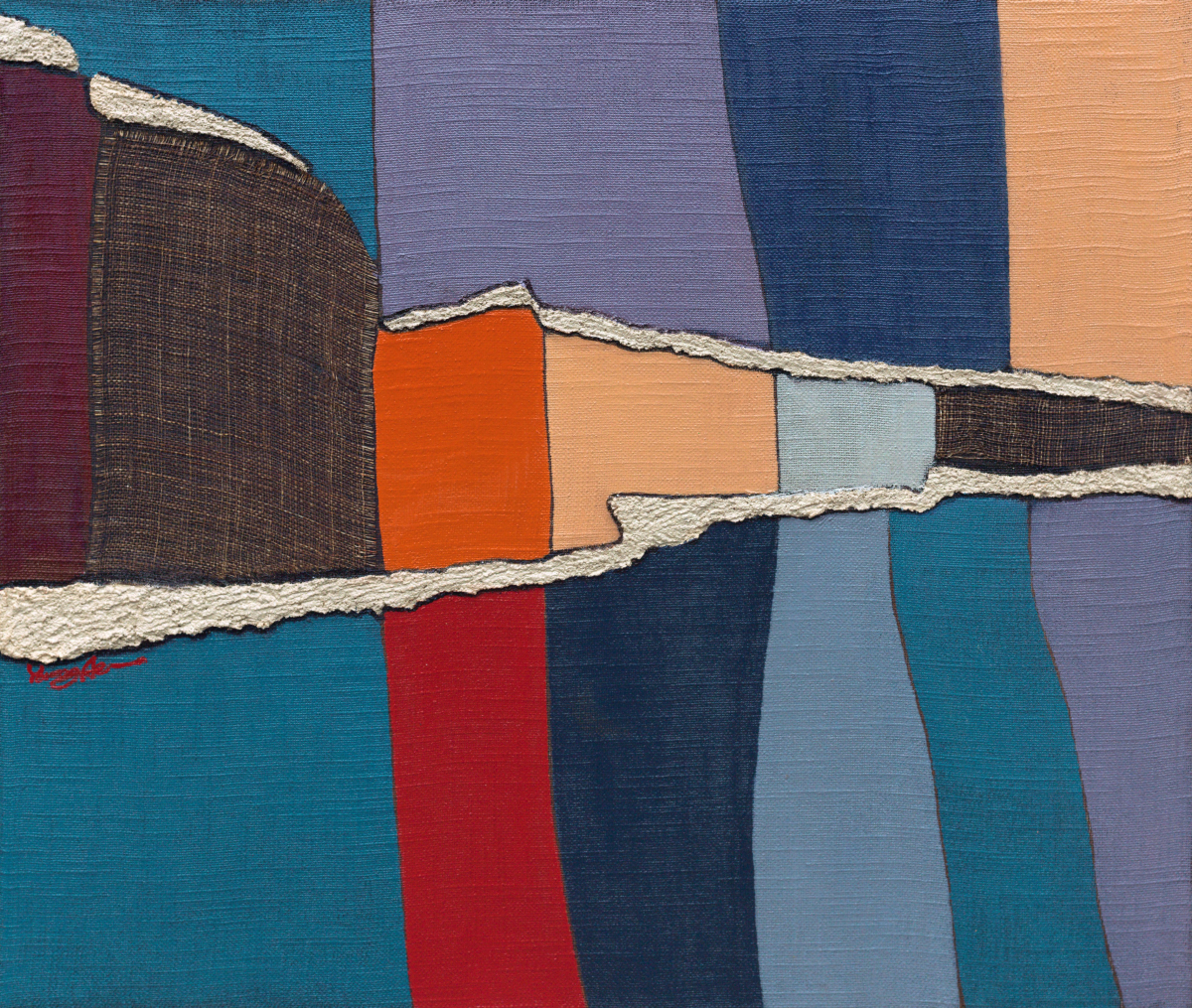
This chromatic intensity is paradoxically sustained by the tactile weight of Kwon’s physical technique, as seen in her piece Itinerary 11. Rather than flattening her surfaces into mere optical planes, the hand-dyed hemp fibers and gel stone build up a substantial impasto, creating a heavy, high-relief substrate. Far from remaining static, this thick, sedimented texture vibrates outward into the viewer's space, generating an active spatial resonance that echoes the materiality of raw haute pâte. Crucially, a textured slit cuts across the middle of the canvas, creating a prominent horizon line that effectively slices the artwork in two. This horizontal division interrupts the composition, allowing the vertical fields of color to act simultaneously as cubistic architectural structures and optical thresholds. Together, these elements pull the viewer into a deep horizon of interiority while pushing the physical, highly tactile plane aggressively forward into the gallery space.
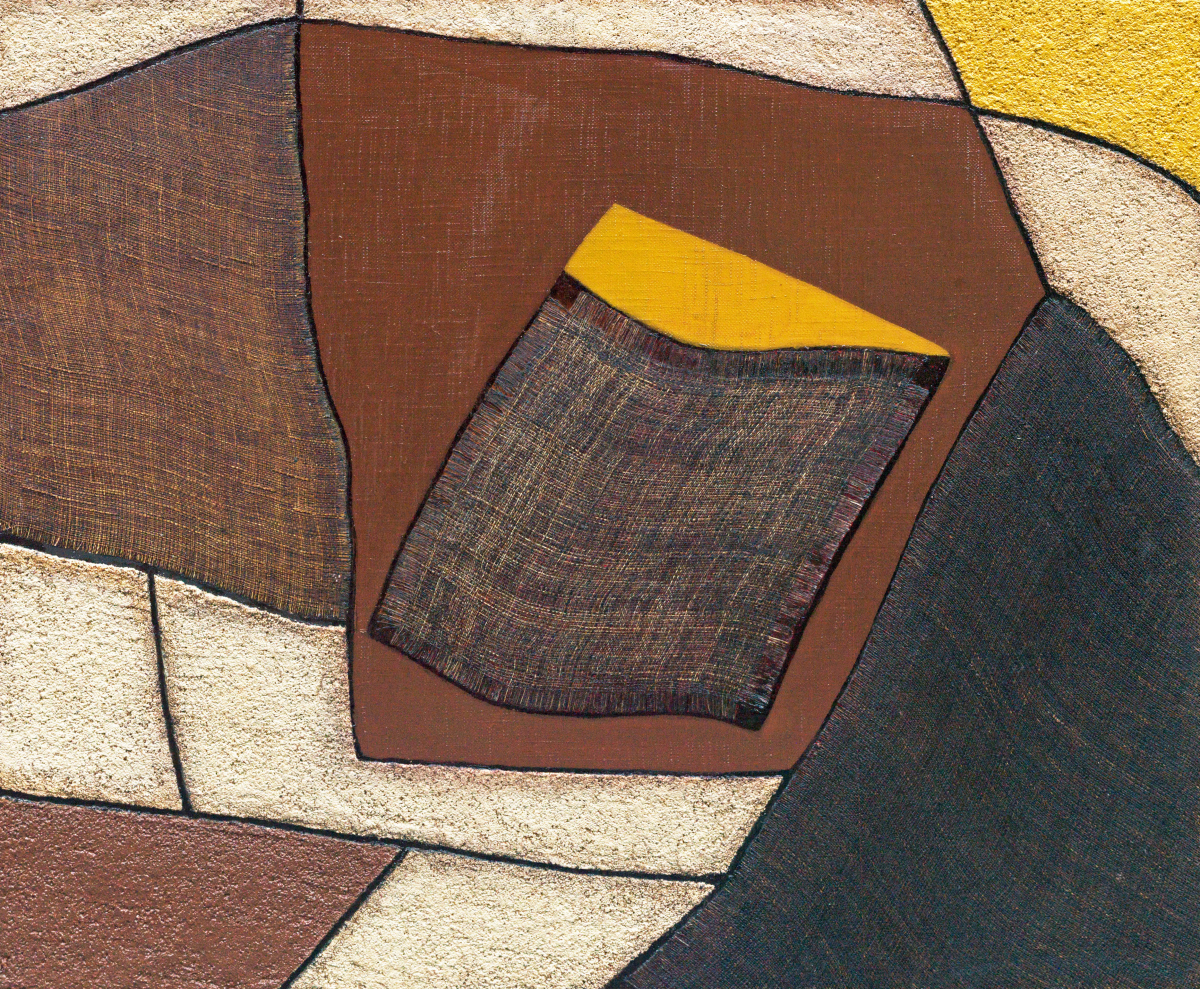
In a sense, Kwon constructs a rigorous architecture of color and tactile matter, synthesizing Western modernist spatial strategies with Eastern metaphysical monism. Kwon’s Renaissance of Grain 3 depicts intersecting planes of coarse handwoven hemp (rendered in cool slate blue, deep charcoal, and rich, earthen umber) juxtaposed against a bold and sweeping crescent of vermilion in a textured field of burnished umber and gold. The fabric’s coarse warp and weft create a tangible physicality that pushes outward from the panel. A wedge of midnight black anchors the upper right quadrant, providing a void that heightens the luminescense of the adjacent orange and gold forms. While the compositions operate through sharp angular geometries and intersecting diagonals, echoing the hard-edged structural vigor of Western avant-garde abstraction, this geometric dynamism is ultimately reconciled through the Eastern principle of gyeol.
An interesting point of convergence exists between Kwon’s practice and Vicky Colombet’s exhibition, Memory of the Surface, presented at Norr Cohan. Inspired by Eastern philosophy—specifically her engagement with Buddhist mindfulness—Colombet similarly tackles questions of time and memory through heavy materiality and tactile electricity, allowing dense minerals and thick pigments to build immersive, almost three-dimensional surfaces. Yet, while Colombet’s abstractions leave time to appear as a fractured trauma, collapsing across the linen like shattered glass where memory exists solely through rupture, Kwon’s work achieves a far more profound artistic resolution.
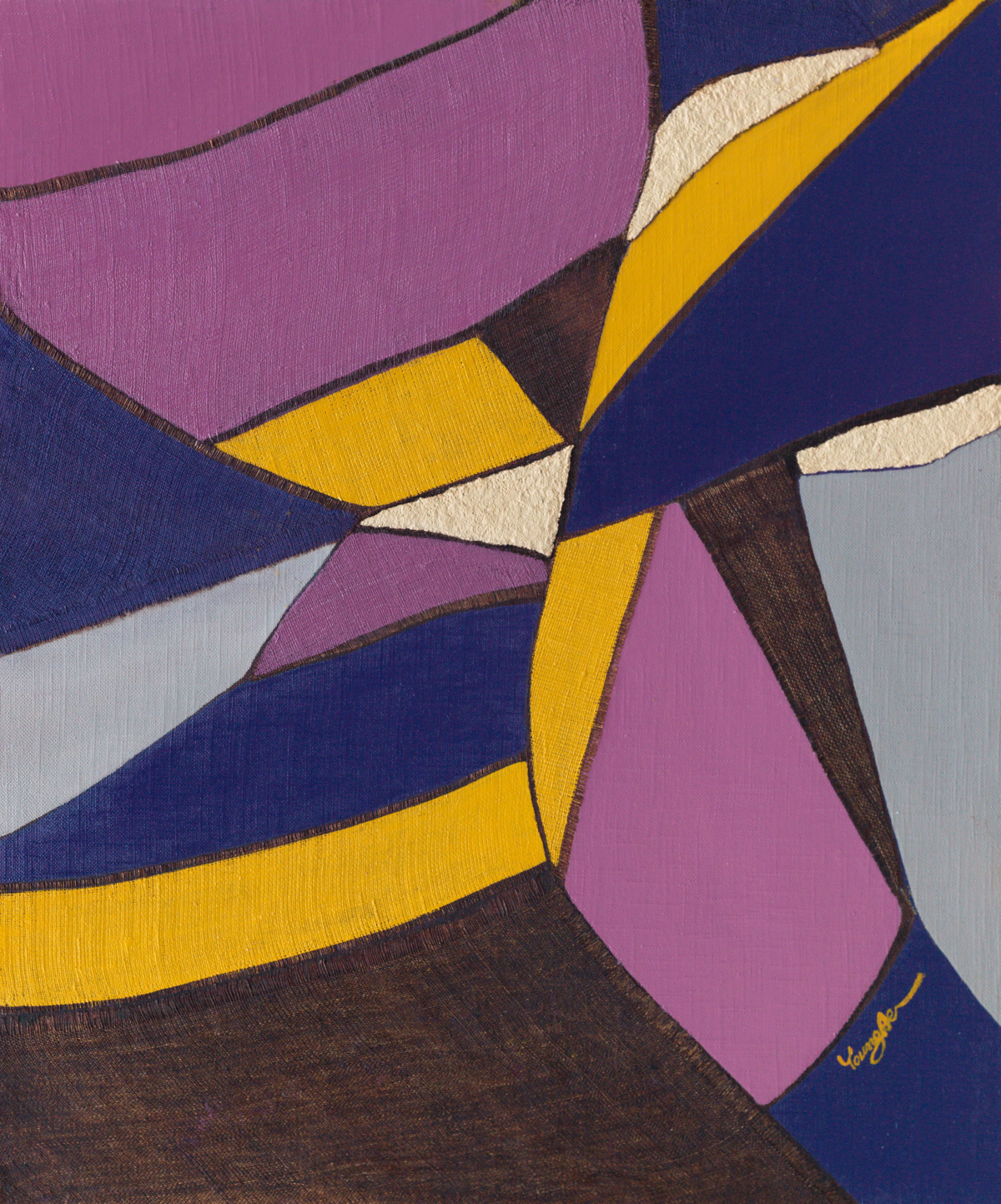
Kwon operates through a rational architectonic principle that structures her colored abstract fields, aligning closely with Adolf Behne’s concept of Architektonik. Unlike Vicky Colombet, whose works surrender to pure chance and traumatic fissures, Kwon constructs an internal composition governed by a monistic search for unity. Rather than treating memory as a passive archive or a site of decay, she understands it as an active, entropy-resistant framework; one that binds disparate temporal fragments into a coherent architecture of the self. By synthesizing these fragmented moments into a unified, structural geometry, her canvases turn the traumatic friction of existence into a durable form of inner endurance, moving explicitly against time and its all-devouring irreversibility.
In The Aesthetics of Grain, Young-Ae Kwon succeeds in organizing the volatile streams of pure color into an indivisible and structural reality. By geometricizing these dynamic fields through gyeol, she transmutes the chromatic force into an abstract, living grain of the self, transforming the canvas into an enduring sanctuary of non-dual consciousness. In doing so, Kwon demonstrates that true selfhood and memory are not shattered by temporal decay but rather are carved and retained against the grain of time itself.