
Xin Song: On the Way to Utopia
Curated by Thalia Vrachopoulos
Tenri Cultural Institute
September 30-October 14, 2026
When a flat trapezoid is rolled up so its two non-parallel sides meet, who knew it forms what is called a "frustum"? The front of the Tenri gallery is filled with a large cluster of these black-and-white conical forms, shredded by carefully cut, tree-like shapes, and they are typical of Xin Song's almost fractal way of working: deceptively simple and super-complex at once. Macro meets microcosm, like a hologram that works as a whole and also as you zoom infinitely in. Dangling rhythmically from the ceiling, the cones disarmed my rational mind, sending me into a dreamy blur toward "the tree of life" the artist mentioned when I arrived, and away from the headache-inducing thoughts of the climate nightmare that seems to pierce almost any mention of nature these days.
The cones are identical, but it is impossible to see them that way. Based on a horizon she once glimpsed in an instant, trees silhouetted against the sky become black-and-white yin-yang forms; to my eye, a forest of thinking caps (as opposed to dunce caps) that could be lowered onto my head to widen my perspective. They cast shadows on themselves, creating a thousand grays, beiges, and silhouettes between absolute black and absolute white, transparent and opaque at once, like a forest within this viewer's soul. From far away, geometry; up close, a tangle of complicated shading.
Nearby, a long scroll, its coiled end unused on the ground, holds a key to Song's background. As a young woman, she left Beijing for the Chinese countryside to study paper cutting and stencils with farmers who were masters of those forms, and to grind colors out of rocks by ancient techniques: powdery turquoises, browns and whites, calligraphic shapes like waves on a river, swirls of clouds like Art Deco commas or chunky chiffon desserts, painted and cut away, added and subtracted. The scroll is a gateway to her more recent work in the back of the gallery. Xin Song's work belongs to the Western art canon, yet reads as if many strands of ancient Chinese painting have been merged into one.
In the cavernous back room, one work stands alone, echoing how Song's black, as with the frustums, is both comforting and foreboding: the nothingness from which the Tao emerges, unborn potential as well as pitch-dark. A single tree climbs toward the heavens, its crown bursting like fireworks into a dome of lozenge shapes that repeats throughout the show. About 30 flowers adorn a bony, thorny collaged trunk rising from black roots shaped like guns, or sharks with predatory fins.
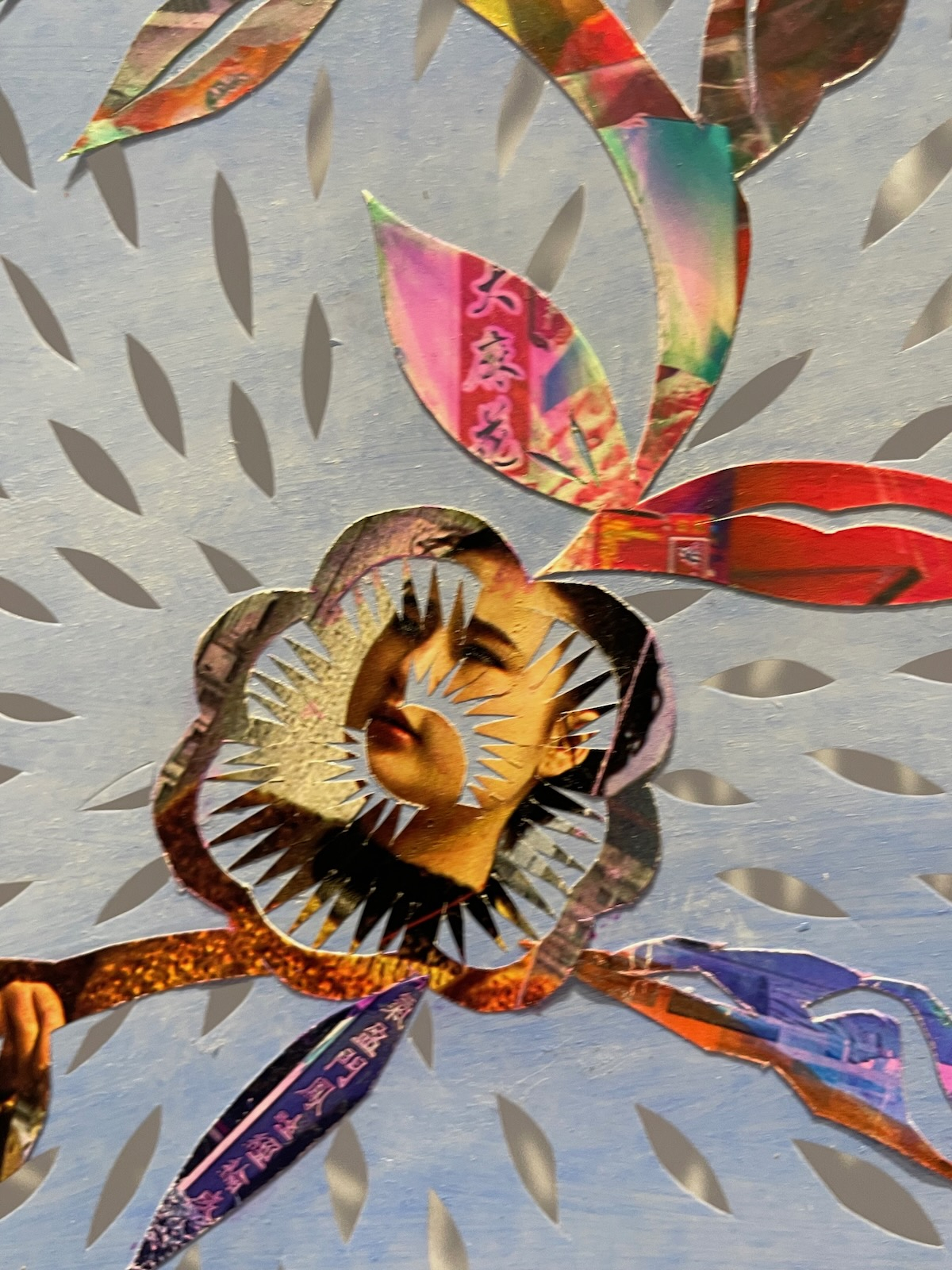
Up close, I see human bodies, faces, stores, roads, lettering, seated Buddhas, typewriters, and doorways like those in an American Chinese restaurant, all serving as placeholders for Song's embrace of her Chinese past. Images are boldly chopped from slick magazines, their writing erased by her cut lines. Paper bleeding through the holes reveals fans, archways, machine parts, stacked umbrellas, and columns from real Chinese architecture, all supporting white flowers with yellow tassels crowned by delicate red threads. Fiber art, collage, painting, and glitter on textured and photographic paper: the paper's viscosity coming toward me and receding, à la Hans Hofmann's push-and-pull.
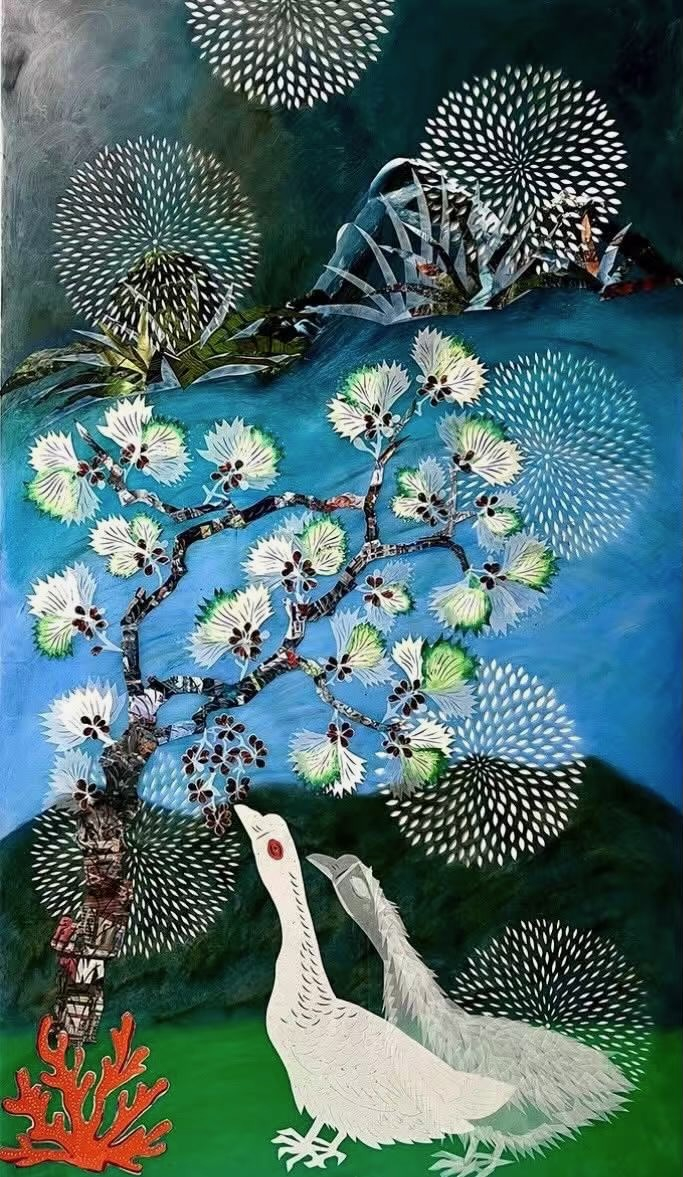
Four major works hold this biggest room. One is literally a Taoist gateway. Two feature pairs of birds; the third is an upside-down weeping willow reflected in water. In one pair, one bird is wispy stacked rice paper, the other smooth acetate with fingernail-shaped holes, a simple contrast that sums up Song's whole way of working. Each contains elements of the other: the rice paper one now has holes, and the Swiss-cheese acetate one sports a collage. Every piece hangs about three inches from the wall on magnets, casting shadows behind it, presumably one of many elegant curatorial touches by Vrachopoulos.
Song's forms are not afraid to look too busy, yet somehow they aren't. Above the willow's dark trunk, a shattered piece of found glass hovers over shimmering branches, color against black, white and gray, echoing the contrast between the front and rear rooms, as if parts of the show are pointing to each other.
Look closely: an owl carved from glossy Western magazine pictures shows her command of every era of Western painting, yet the effect is very Asian, sprinkled with an actual clipping of the magic kingdom of Disney that has departed China. There are brush strokes, manufactured fabric, chunky stitch marks from her fiber arts background. Fragments are sometimes glued flat, sometimes hovering to cast shadows. Faces and Chinese letters are carved out of a leaf or flower. The lozenges become rain, then emanating light. Sephora, Zara, and KFC logos surface in the sea of cutouts, evoking the late '80s, when Western logos like Disney first arrived in China, just before she moved to the United States. Elsewhere, a Chinese urban landscape with car headlights retreats into the distance is visible but only close up.
Exotic birds with large purple eyes look at us and at each other like lovers, part messenger, part self-absorbed symbol. Finally, a beautiful palace door, a tree on either side, each with two birds, beckons us toward a majestic orange sunrise and an inner Taoist kingdom. Here the lozenges resemble eyes, eyebrows, pursed lips. A leaf may hold a picture of a leaf, an engraving from currency, or a cut-out luxury watch, maybe just the word "quartz." The giant orange sunset looks almost mopped on, yet majestic and immense, carefully random like the shadows cast by arrays of punched holes on the gallery walls.
A final suite of six smaller tree and flower images sits in intricately sewn mesh fabric frames, punctuated again by that mysterious black: smoke rising from a river while a thousand butterflies rise from the trees; leaves like female genitalia on a riverbank; bamboo with black rocks and snowflake-like leaves; a winding road toward a mountain and lake. Several contain a collaged orgy: piles of mostly female body parts cut from periodicals, black and white and in color, crotches, thighs, fingers digging into flesh, garters and straps. One features a little fanged creature, perhaps a dog. A fleshy extremity in a tree trunk is tagged with the word "invisible," ambiguous, yet somehow a label of honor. There are red flowers like playing card clubs before purple and magenta mountains, snake-like plants against stitched white mountains, blue plum blossoms lost in a form made from a scribbled $100 check.
To me, this series, with eye-popping foregrounds that are over-the-top, layered, clashing, and chaotic, is built atop traditional Chinese ink strategies and classical lakes and mountains that provide a quintessential foundation beneath the turmoil, and somehow it all works. This is indicative of the entire show. To my Western eye, this is an exhibition of stunning Chinese brush painting tropes gone rogue. But when I asked Song about this, she said emphatically no to the tropes and yes to the rogue: she lives to get away from such things and takes no responsibility for adhering to those ancient Chinese prototypes or any rules. But she does value that they lead back to her wellspring. Later, she even shared childhood memories of the "Four Gentlemen" that every Chinese child knows: plum blossom, orchid, bamboo, and chrysanthemum, which stand for pride, elegance, resilience, and detachment, respectively.
Not much of a flower person myself, I do know elegance when I see it, and my flowery descriptions here of Xin Song’s elegance suggest my gratitude that her art pushed my intellect aside and has allowed me to wax poetic in a part of my being that I seldom treat myself to. Perhaps it is that liminal realm between the left and right halves of my brain, where Eastern and Western art could meet. Perhaps it could even reveal a rational way to a future that will save nature and us from ourselves. - Mark Bloch