
“I am looking at myself in the mirror and taking notes. That sounds like I’m a stenographer taking quick looks at myself, then scratching it down on a pad. But I keep getting up to look at myself, and sometimes I’m seeing something I didn’t the last time,” observes the slightly uncloseted Eddie in Marlon James’ The Disappearers, a 613-page novel the New York Times claims is possibly the best of the century.
That description also befits two of the lead characters in Anuparna Roy’s far-less-time-consuming Lovers in the Blue Night, a nominee for the Queer Lion and winner of the Best Asian Film at the Venice Film Festival. Here’s a couple who often seem to be staring at their own reflections and at the world at large with a discomforting uncertainty.
They have good reason to. After all, the two are now living in near poverty in a little one-room hut in Mumbai, a city in a land that enjoys deporting their sort. Their bed is a mat on the floor enveloped by mosquito netting. Their clothing and other goods are kept stacked in cloth bags. Is this a step up for the duo?
Well, Karim (Pritam Pilaniam) and Ameena (Neelima Sharma) met and wed after their Bangladeshi village was flooded and all their kin drowned. “Men under water; fish on land.” A state of affairs that a now-deceased relative of Karim predicted would reflect the chaos of life.
At night they sleep next to each other fully dressed, but untouching. Proximity without intimacy.
By day, Karim rides his bike with a sign boasting his profession: “Rat Killer.” But he is a kind Rat Killer, often capturing the vermin and setting them free in open, more welcoming landscapes.
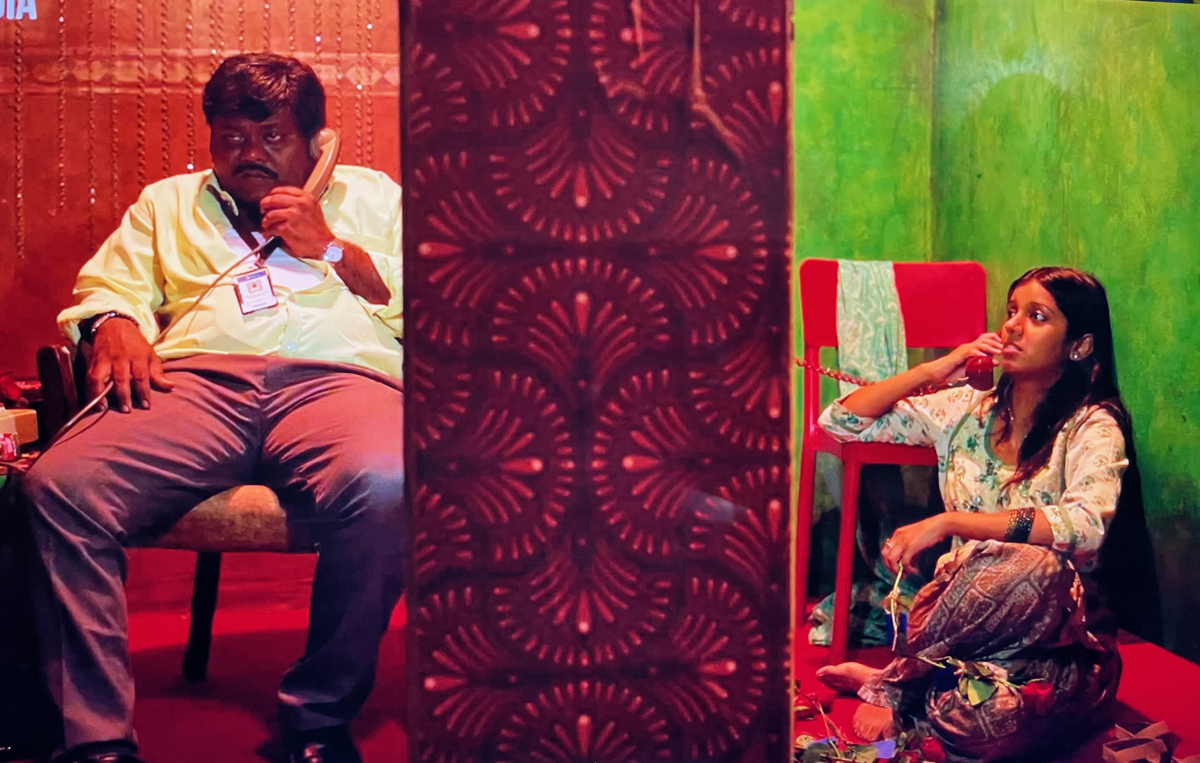
The highly innocent and no doubt virginal Ameena is working as an erotic phone performer in a bar called the Blue Night. There, the hired ladies are placed in separate tiny rooms next to adjoining tiny rooms housing the johns. The men call the gals up and converse with them. (Think Love is Blind.) If the gents are enjoying themselves, they’ll slip roses into the next room through a space at the bottom of the walls, blooms that were purchased from the owners of the establishment as tips of affection. Sometimes hands are even touched in the exchange.
But when a phoner falls for Ameena’s gentleness, he asks for her name. She refuses, quoting her parent: “My mother said that once you reveal your name to a loved one, you become strangers. All that remains are two names all alone. The person within drifts away.”
No wonder her boss tells her, “Your hesitant Hindi is so sweet. You can satisfy a man so quickly.”
Arousing and aroused at work, while denied on the home front, Ameena gets more and more frustrated: “[Karim’s] never made me feel like a woman.”
She’ll even be more upset if she ever learns that her spouse is gay and currently in love with a small-time, bisexual thief, Suka (Bhushan Shimpi), who heads a gang of bumbling burglars. Karim eventually joins the crew, and when not bottoming for his bumptious lover, he unenthusiastically employs his rat-poisoning skills on a few barking pets, canines that might impede the burgling of their owners’ homes.
Beautifully shot by Debjit Samantam, Lovers in the Blue Night has much more on its mind than just sexual frustration. Roy, who also wrote the screenplay, explores the plight of immigrants, corruption within Indian politics, homophobia, and the limitations of women’s rights and education. Ameena, for instance, was never taught to read, which is especially problematic when she receives love letters.
As for the impoverished, Suka notes to a sorrowful Karim, after the killing of a wealthy person’s pet, “Ten people will show up for this dog’s funeral. For us lot, our bodies will rot in the gutter,” a piece of dialogue that, when intertwined with the film’s coda, recalls Pauline Kael’s take on the great Satyajit Ray’s The Apu Trilogy: “Ray sees that life is good no matter how bad it is.”
(Lovers in the Blue Night was screened at this year’s Toronto International Film Festival.)