
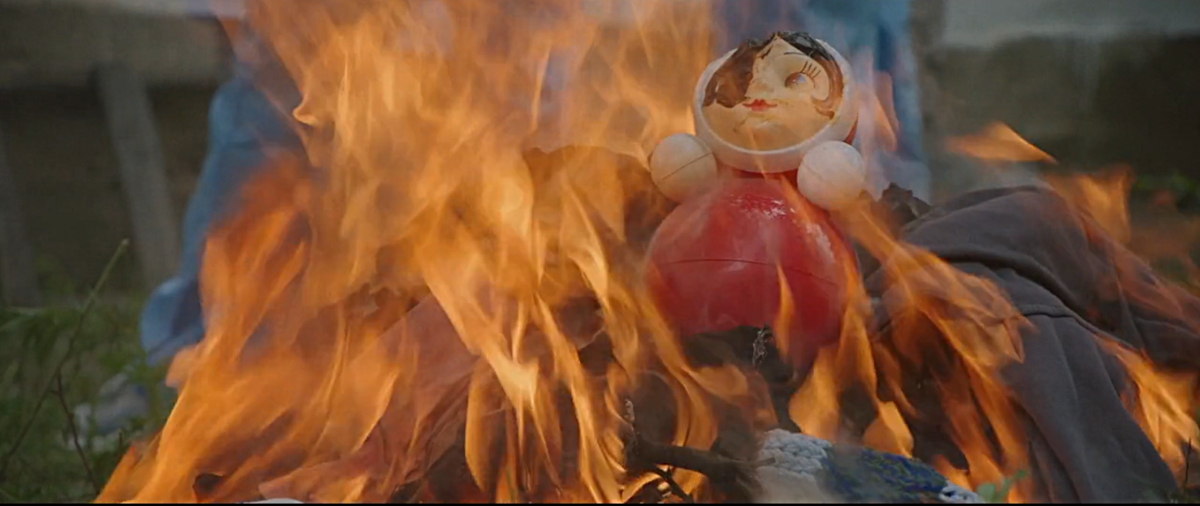
Bit by bit, layer by layer, the new suspense/horror film Burning examines the same set of facts from different points of view. None are those of the principals: Husband Marat has brought his mother, Farida, to his modest house to care for his wife, Asel. The couple recently lost a son, and Asel is pregnant again— at least according to some accounts. That’s the film’s conceit. The events are viewed through the gossip of the neighbors in their ramshackle, tin-roofed town. Everybody meets at the local bodega, and everybody has their own version.
One version has Mom as a witch, given to incantations and casting spells. Her care for Asel is vindictive, and she has the young mother crawling across the floor and vomiting maggots before the men in white come to take her away. Another neighbor contradicts: it’s actually Asel who is malevolent, possessed by a jinn, an evil spirit. In this case, the men are not mental health goons but Muslim mullahs recruited to exorcise the demon out of the young wife. Yet another account frames a different villain. It’s all hearsay, of course, which rolls out a Rashomon tapestry with hints of Rear Window that appears to be the point of Burning (the title refers to the ritual incineration of the first child’s clothing and toys).
It’s all very intricate, and for the most part well-executed. I’d never seen a film from the Central Asian country of Kyrgyzstan and was impressed by its confidence and quality. Director Radik Eshimov has a number of Kyrgyz feature films on his resumé. He and his crew have absorbed the technology and aesthetics of Western filmmaking, and his cultural cues are few, notably certain etiquettes and the mullah business. As a result, the film could take place anywhere at any time. You don’t have to go far to find nosy neighbors.
The actors too are entertainment-world class. Aisant Edigeeva (Asel) and Omurbek Izrailov (Marat) have the most to do, but it’s Kalicha Seydalieva’s (Mom Farida) performance that is the most varied. Her seasoned range of emotions holds the distinct parts together. Her cartoony-ness in the first segment, with her as an evil conjurer, gives way to more subtle acting that makes her Burning’s emotional barometer.
The first segment is the most effective: it’s complex and visually striking. Cinematographer Kerim Kasymaliev packs the frame with dense colors and ominous patterns: the suffocating wallpaper matches the adornments of the clothes and the bars of the absent infant’s playpen. The special effects are properly repulsive. Throughout, Bakyt Kemelev’s score has a buzzing, ominous quality, yet another Western trope. Writers Aizada Amangeldy and Dastan Madalbekov construct a complex maze of business based on rumors that ultimately purports to get at the truth.
Which is Burning’s biggest flaw. It’s a “tale” that I’m sure plays well at fantasy conventions, etc., but sidesteps a deeper truth. It’s a Western trope as well that a film can present multiple versions of an incident in 90 minutes and wrap it up with one that’s definitive. Burning doesn’t tease the intellect (like, say, Rashomon) or even invite the audience to solve the mystery itself, since it withholds vital facts. Its stakes are too low, and its conclusions too pat, to say anything interesting about the hive mind, which appears to be its ultimate theme. Hive mind is a Western blight, and overtold tales normalize it. One could look to small films from tiny countries outside the Hollywood sphere — like Burning — to challenge it or shed new cultural light on it.
_______________________________________
Burning. Directed by Radik Eshimov. 2024. In Kyrgyz with English subtitles. Available exclusively on Indiepix Unlimited. Runtime 101 minutes.