
KARIN DAVIE: It Comes In Waves
Through 20 December 2025
Karin Davie is famous for a suite of extraordinary paintings that she showed in the 00s. They seemed to be her last word on the Stripe Painting, which had been her subject since the early 90s. She cut the stripes loose from the edge, and they recoiled like heavy rubber bands. These large abstract works consist of wildly interweaving fist-sized strokes on a coloured ground. The lines are painted wet on wet, picking up colour as they travel, each brush stroke loaded in such a way as to imply weight and volume and evidence of a light source or sources hitting the surface of the line. She never lets you forget, however, that this is paint speaking the formal language of Art.
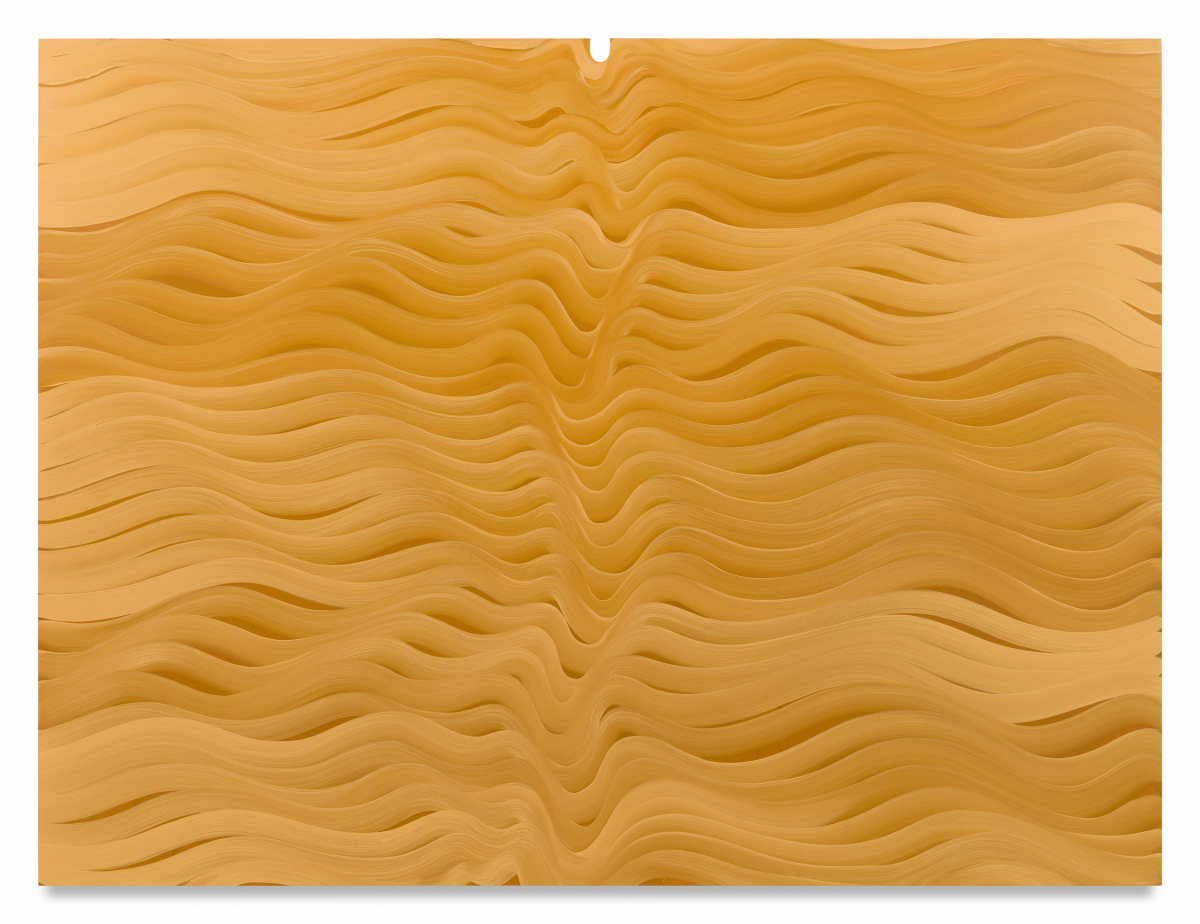
In her dynamic new show at Miles McEnery, the stripe is back with a new set of instructions. The show consists of two sets of glorious paintings. Two red wave-like paintings, made up of two joined canvases, and a second group of wavy paintings, each in a predominant colour. They are unusual colours that can appear natural, artificial, or both. All of the second set has a divot cut into the top in the middle of the canvas, as if a giant's thumb has pushed into the picture plane.
"Trespasser No 4" is a particularly lovely golden-haired painting. Lines move horizontally in sensual gestures from one side to the other with a kink in the middle, so that by the time the last line is made, there is a groove or path running vertically through the canvas, finishing at the cut-in divot at the top. As the line moves, it picks up lighter or darker versions of the prevailing colour. The way that darker tones gather in parts of the image makes me think that the shadow of clouds has been cast on Van Gogh's "Wheatfield with Crows." The line sometimes stops firmly before the edge or runs on as if it didn't exist. Drawing attention to the formal limits of the canvas and then sometimes totally ignoring them.
Words have worked for Davie in the past. Not in a literal way that say "container" did for Ross Bleckner with his paintings of the '90s made in the shape of urns. But her '90s pieces were "wavy" Davie's and sometimes "curvy" Davie's. But after the '00s, she began looking inside for inspiration rather than at how she looked from the outside.
"Abstractionists see no more sections, no divisions between different sections of reality, and this is not surprising since reality has been transferred from the outside to the inside of the artist, where experience is all one, and everything exists on the same plane." - Guillaume Apollinaire
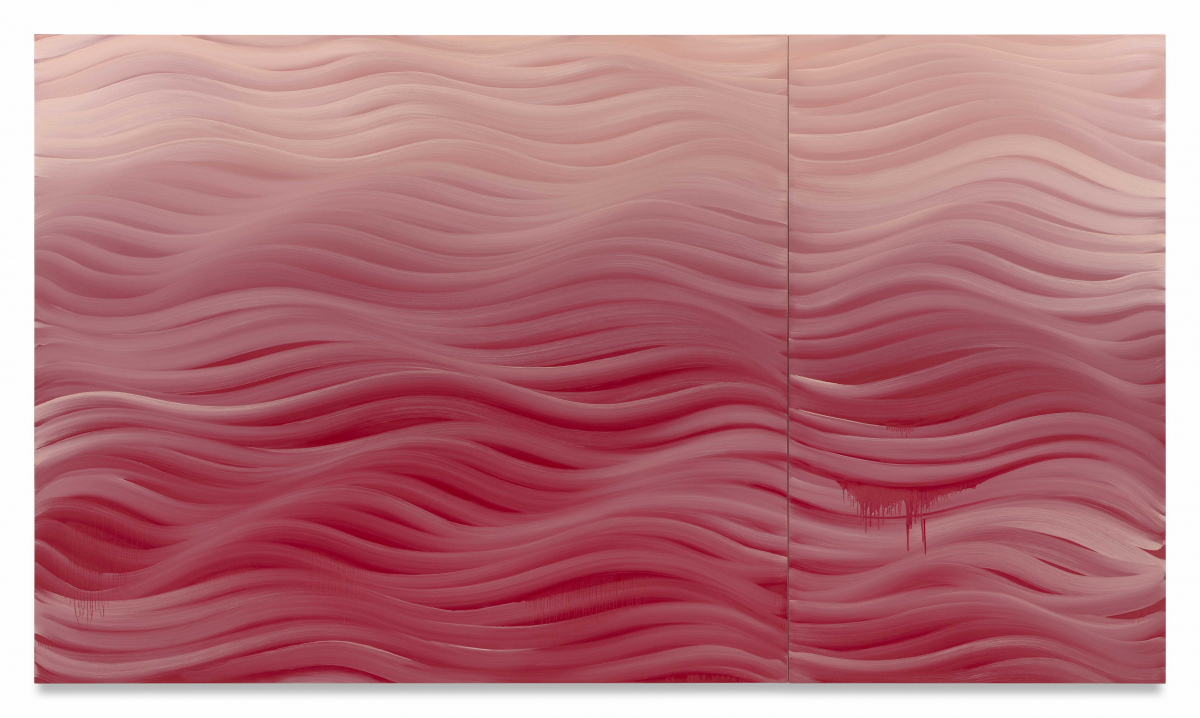
A more internal perspective persists in the Red Wave paintings. In "Strange Terrain No. 5," we are reminded of both the sea and the body. These are gorgeous paintings, but she doesn't let you just fall into fairy-tale beauty. She brings you back to the real condition of the body. At one point, a cut opens up between the lines and drips over the undulating surface.
There's a carnal shadow. It's not only a billowing pomegranate sea at dusk, but it's also viscera heaving with the breath, the tissue that covers the ribcage.
Both Strange Terrain paintings are composed of two canvases. It means that when she is painting the horizontal stroke, she has to stop and then continue the line again on the next canvas. This deliberate obstruction asks the question, 'Is the action still authentic if it is made a second time?'
Or in this case, if the line is continued.
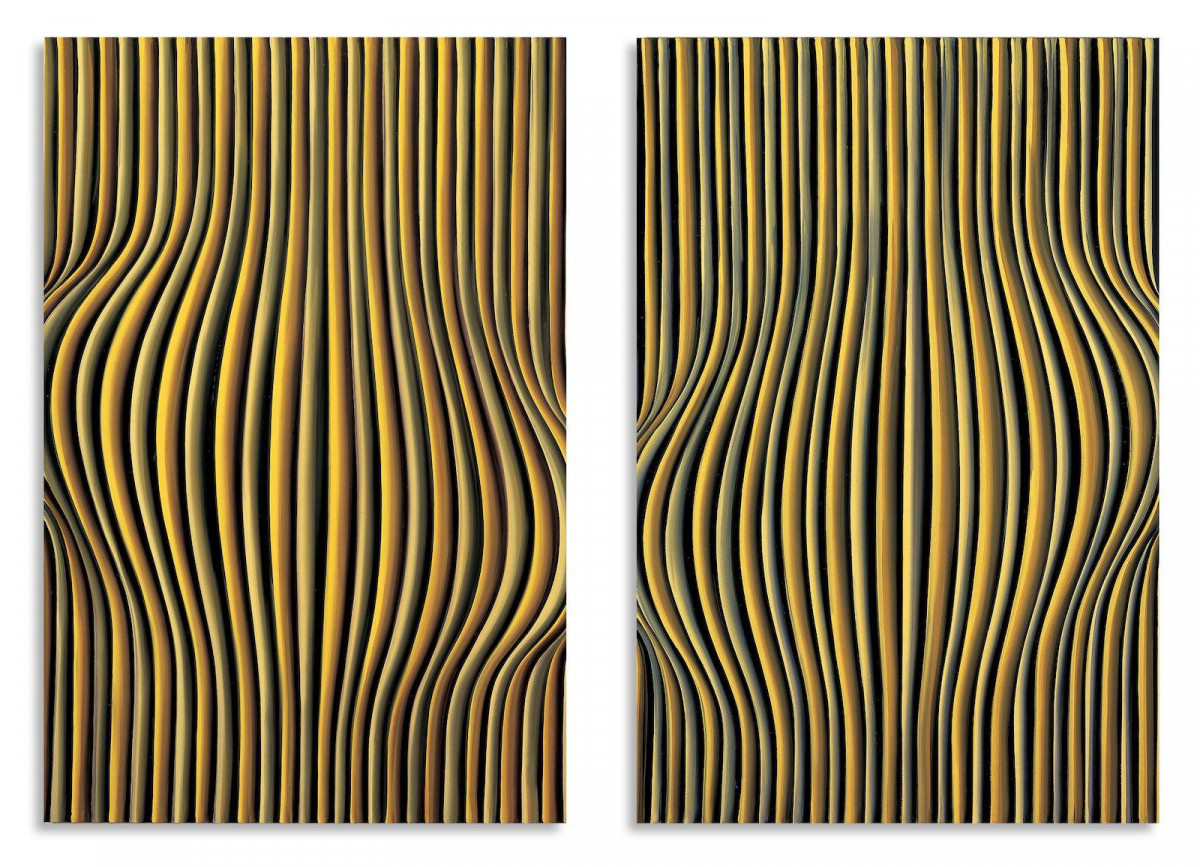
It harks back to one of her earlier diptychs like "Ummm….#1 & #2," 1993. Part of the Sidewalk series. Where a curvy form covered by stripes had to be repeated in the second painting.
This emphasis on the performance side of painting reminds me of the difference between the guitar playing of Jimi Hendrix and Marc Bolan. It didn't matter whether Jimi was playing with his teeth or behind his back; you took the notes he played to be an authentic response to the music. But in a performance by T Rex at the Rainbow music venue in the early '70s, Marc ran his tambourine up and down the neck of the guitar until he finally ejected the tambourine into the audience. It really didn't matter what the sounds coming out of the speaker were; it was about the performance of the action. Marc was no slouch as a guitarist either, but he sometimes used the guitar as a prop as well as an instrument.
While I recognize that this example is not exactly the same thing, because Karin very much cares about what the painting looks like. I'm just using it to make a comparison between how glam was much more playful with the rock music form in a way that is similar to how the post painterly abstract artists used Minimalism. The exact same thing would be if Marc played an impassioned solo and then reproduced it, immediately note-for-note. That would be very Karin Davie.
Karin's work is about aesthetics and poetry. She asks: can a painted performance be authentic? Is the edge of the canvas the end of this particular state described by the painting? At the same time she's alluding to places and things in an optical way. This line casts a shadow, this one emanates light. This picture reminds you of waves. Consequently, the image seems to shift constantly between different states.