One of the joys of theater can be the element of surprise. It is going into a new musical with minimal expectations, only to be pleasantly surprised to find that the show is genuinely entertaining. That happened when I saw Cry Baby, the new musical based on the John Waters cult movie (which starred Johnny Depp). I thoroughly enjoyed the Broadway Cry Baby. It is by no means a great musical, and it certainly doesn’t break any new ground, but I had a smile on my face through most of the evening. While Cry Baby doesn’t have the show-stopping excitement or emotional pull of Hairspray, the hit Broadway musical also based on a Waters film, I found it to be far superior to other Broadway movie adaptations such as High Fidelity and The Wedding Singer, and better than the likable but uneven Legally Blonde, which has been running for over a year now.
The "endgame" could go on for years. Every day is a bit of the endgame. But then, one day, it might actually be the end of the endgame. This is Samuel Beckett’s insight, his truth, played out in his works, whether the play is Happy Days or Waiting for Godot, or the actual Endgame.
In chess the endgame is the period when the game is dwindling down, most of the power pieces have been lost on both sides, leaving the two kings, perhaps a few pawns, and mostly self-protective moves. It’s likely to end in stalemate unless one opponent grows bored or distracted so that the other can actually move to checkmate.
I had heard so many good things about the new Broadway musical In the Heights that I was hoping for more from this show, set in the largely Latino Washington Heights section of Northern Manhattan around a July 4 holiday. I didn’t dislike it; in fact, I very much admired its spirit and energy. The score, written by the show's star, newcomer Lin-Manuel Miranda, is appealing, with its Latin-flavored, hip-hop, and rap numbers mixing with some more traditional Broadway sounds. There were plenty of virtuoso performances, and the second act had some touching moments. But, overall, largely due to book and story issues and a major lack of character development, I just couldn’t get totally involved in In the Heights.
Once upon a time in the 1940s and '50s they wrote truly great musicals in America, and Rogers and Hammerstein’s South Pacific is one of them. From the moment the Lincoln Center orchestra strikes up the overture, a mood of lush romance and wonder settles upon the theatre. The music is exquisite. And this production lives up to the high level set by the very talented composer and lyricist.
Somehow it is just the right moment for a revival of this 1949 classic musical. Yes, it is set in the South Pacific Theater during World War II, but it’s not the relevance to our day that makes it work.
The Homecoming is not my favorite Harold Pinter play, but almost any Pinter play tends to be better than anything else around, so it is wonderful to have this production on Broadway until April 13. I certainly recommend going. With Daniel Sullivan directing competently, and such fine actors as Ian McShane and Eve Best starring, it is effective in exactly those jolting ways that characterize early Pinter works.
The play is mean, funny, dark, disturbing, and mysterious.
Sitting in the audience at PS 122, gazing out at the barely-adorned stage, taking in the sound of a piano played by a woman dressed in Victorian clothing, one can easily feel the pleasure of having stumbled onto something that few know about. But with PS 122 being one of the city’s premier avant-garde performing art showcases, and the show having won U.K. critics’ accolades and several awards after appearing in the Edinburgh Fringe Festival, any sense of having “discovered” 1927’s Between the Devil and the Deep Blue Sea is of necessity false.
Samuel Beckett is the premier absurdist playwright of the twentieth century, a “classic” so to speak. But as the decades pass, his work is performed less often in Manhattan. New York Theatre Workshop is presently staging what they have titled Beckett Shorts, consisting of Act Without Words I & II, Rough for Theatre I, and Eh Joe. And we should all be so glad that they are.
The production is a small jewel: precise direction by Joanne Akalaitis; original, atonal music by Philip Glass; effectively simple stage design by architect Alexander Brodsky; and brilliant acting by Mikhail Baryshnikov and Bill Camp.
Tracy Letts’s new play August: Osage County, directed by Anna D. Shapiro, is a brilliant indictment not only of the American family—which has taken plenty of hits over the years, and rightly so—but of America’s culture and history as well. In fact the dysfunctional Weston family is a metaphor for the American people. They live on the former Great Plains, 60 miles northwest of Tulsa, Oklahoma, the true heartland. Just as the Westons drink, pop pills, attack each other, cheat on their partners, and rage at perceived insults and old humiliations, so do we all in this great imperialistic consumer culture we call our own.
So many new plays these days are painfully short of substance, with the only reason to see them being the top-notch efforts of the city’s endless supply of talented actors. Adam Rapp is one of the few exceptions to the lazy playwright rule. His plays, from Stone Cold Dead Serious to Red Light Winter to Essential Self-Defense, are always so multi-layered, intricate, and intelligent that multiple viewings seem necessary. Fortunately, the stories he tells and the characters he tells them through are always so interesting that the idea of seeing the shows again is far from a problem.
Without a doubt, Ivo van Hove is a talented, edgy director. His take on Moliere’s The Misanthrope, playing at New York Theatre Workshop, is hyper-modern, energetic, larger than life, and urbanely witty. The stark set suggests a contemporary loft, where artistic, showy, high performing people gather to tear each other apart. This 17th century French comedy, translated by British poet Tony Harrison, seems very of the moment in Hove’s production. The articulate crowd of characters all carry ever-active cell phones and Blackberries, wear stylish dark suits, and snap in and out of their social interactions with the attention span of hyperactive four year olds. Each is self-centered to the max.
The audience never sees the title character in Ann-Marie Healy’s new play Have You Seen Steve Steven?, the character being a long-forgotten imaginary dog “owned” by two teenagers when they were little. But the long-disappeared phantasm of the dog turns out to be a central character, even the key character, in this darkly funny and thoughtful play, which features several excellent bits of acting, though the ending is a little too strange in the end for its own good. Resurrected by two people who seem almost as imaginary as he does, Steve Steven shatters the complacent Midwestern world of the teens’ two families, bringing the divisions already present into high relief.
If you've ever been stuck in a car for a long ride with relatives with whom you have, at best, a love-hate relationship, you could sympathize with the plight of the characters in Anastasia Traina's new play From Riverdale to Riverhead, at Studio Dante. Unfortunately, the experience of sitting through the play is not unlike such a road trip, with bursts of giddiness and warm feelings punctuating stretches of sullenness, frustration, and irritation, as well as an undeniable sense of relief when it's over. Despite some good efforts on the actors' parts, the characters are tough to like, and without a sympathetic point of view through which to enter their world, any comedy and drama in the story are hard to pick up on.
In Scenes from an Execution, Howard Barker recreates the contentious, inspired world of artistic Venice in the 1570s, populating a rich historical landscape with fictional painters and patrons. But the themes and emotions the play can arouse in an audience today, as in QED Productions’ current revival, deftly directed by Zander Teller, pulse as though modern, and almost factual. The characters’ tangled relationships and loyalties, portrayed with intensity by the leading actors, not only draw you into the individual struggles that shape them and their world, but demand your engagement from start to finish with the intellectual and moral issues from which those struggles are born.
In our ultraconnected, seen-it-all modern world, it’s hard to imagine that magic (for lack of a better word to describe the strange, unknown, unexpected) is anywhere anymore, or that anyone might still want it. But watching The Debate Society’s terrific new play The Eaten Heart, one realizes with relief that yes, there is still the more mysterious, older kind of magic to be found and people do still seek it, though it’s hardly obvious or easy to recognize.
The Brooklyn-based troupe’s second installment in a promised trilogy of plays based on stories from Black Plague times (the first, The Snow Hen, premiered last February), The Eaten Heart springs from Boccaccio’s Decameron, though even people in the audience who are somewhat familiar with that early novel may initially have trouble recognizing the fragments from it that have been spun into the play.
Fairly early on in An Octopus Love Story, Michael Cyril Creighton (above left), as the cuttingly intelligent and self-important Alex, a gay man, meets Kathy, a good ol’ Texas gal played radiantly by Krista Sutton, and he is, it seems, genuinely enchanted by what he finds. It’s a sweet moment, but it passes quickly, and one might dismiss it as the mere attraction of an effeminate man to a very strong feminine presence. But the encounter’s mix of the retro and the quirky, old values and new, nicely echoes Delaney Britt Brewer’s flawed but entertaining new play as a whole. It’s about neither octopus passion, as the title would suggest, nor about same-sex love and marriage, as the first main thread of the plot suggests – though both are elements – but rather turns out to be broader and more conventionally romantic at its core, articulating an anguished cry that goes back to Romeo and Juliet and before: We can’t help who we love, we just love.
British theatre has been a reinvigorating force in New York for some time, with the best of the West End coming over and showing us how it should be done on Broadway, and hits from the Edinburgh Fringe Festival offering new ideas to the off-off-Broadway scene when things get stale. So one might have been justified in thinking that the choice by the eXchange, a new company rising from the proverbial ashes of the Jean Cocteau Repertory, which disintegrated earlier this year, to use premieres of two British plays in its inaugural season was a smart one. Unfortunately, neither of these plays is strong enough to make one look past the weaknesses in acting and direction that plague both, and the combination prevents these debuts from feeling very auspicious.
Realism, by Anthony Neilson, is the less satisfying of the two. It’s something of a head trip, with the head in question that of Stuart (Stephen Plunkett), a whiny layabout who’s depressed and questioning the meaning of his life because he broke up with his girlfriend and now she won’t call him.
The bi-monthly works-in-progress series for movement-based artists called Throw gives performers an opportunity to interact with the audience in a unique way. Held at Galapagos Art Space in Williamsburg, the programs consist of three short segments. After each segment, the performers ask the audience questions.
Sarah Maxfield, co-founder of Red Metal Mailbox, curates and moderates the series, which began in June of last year and has allowed numerous dancers a chance to gain insight from an audience. “I’ve been pleasantly surprised with the way people jump in” responding to the questions posed by performers. “Their opinions give fantastic feedback.”
Arriving in the Flea Theater’s downstairs space to watch Julian Sheppard’s new play Los Angeles induces some fairly strong cognitive dissonance. A show about sprawling, soul-sucking, terminally uncreative L.A. put on in a tiny, dark warren-like space by one of New York’s most innovative acting troupes? How can that possibly work? And yet, although Sheppard’s play itself sometimes falters on a compositional level, in terms of the writing and pacing, the cast’s outstanding acting and the sense of humor director Adam Rapp brings to the play give it a memorable bite.
The play takes place in a series of vignettes that, essentially, follow a young woman’s destruction, which is both self-inflicted and spurred by others.
It must be true that most revolutionaries, if they live past the age of forty, lose their influence. The ironic hero of Tom Stoppard’s trilogy, The Coast of Utopia, Alexander Herzen is described by a spokesman for the younger generation in the final play, Salvage, as “sentimental.” Worse still, “his ideas are extinct.” This is said of a man who has dedicated himself for the past thirty years to the cause of freedom and political reform in Russia. But “reform” is too tame a concept for the new young men, who are both more pragmatic and more violent in their ideology. Whereas Herzen — compellingly embodied by Brian F. O’Byrne (pictured, with Martha Plimpton) — says of the on-going situation, “we have to be patient,” the younger men reject “progress, morality, and art.” Now they are nihilists who will smilingly destroy all.
Nobel Prize winner Jose Saramago’s novel Blindness is a deeply unsettling meditation on human nature and how quickly human society can unravel when people are gripped by irrational fear. In many ways its mood echoes the similarly cautionary tale of Ray Bradbury’s Fahrenheit 451, which Godlight Theatre Company adapted strikingly well last year. So one would be justified in expecting that Joe Tantalo (founder/artistic director of the company) would have comparable success adapting Blindness for the stage. Unfortunately, the new production, which opened Tuesday at 59E59 Theatres, does not live up to those expectations. Despite the inherent tension of Saramago’s story, the plot drags here, with the most striking bursts being those of violence, making for a display that is often physically horrifying, sure, but that fails to strike the notes of moral horror Saramago achieved on the page.
How often does one go to the theatre and get to hobnob on the stage before the play starts with all one’s fellow theatergoers and the star?
We are served champagne on the drawing room set. It’s a discreet little party, with the guests just slightly shoving in that aggressive New Yorker way towards a moment of discourse with Wallace Shawn. And, yes, he stands there in his tweed sports jacket and discreet tie, beaming, and gabbing away like a genial host.
Tom Stoppard has bitten off a huge mouthful of Russian history with his trilogy at Lincoln Center, The Coast of Utopia. It’s a brilliant production so far, with the first two plays, Voyage and Shipwreck, having opened. The narrative concerns a group of political revolutionaries—Bakunin, Herzen, Belinsky, and others—from the 1830s and 1840s, precursors of the Russian Revolution of 1917, but so far in advance of their times as to be more dreamers and talkers than actual soldiers of the revolution. Revolutions of a sort were occurring in Western Europe (like the brief one of 1848). But most of Russia was still asleep, under the repressive Tsar Nicholas I, and that situation drives these passionate men first to heated political discourse, and later to travel abroad to Paris and other European hotbeds of exile activity.
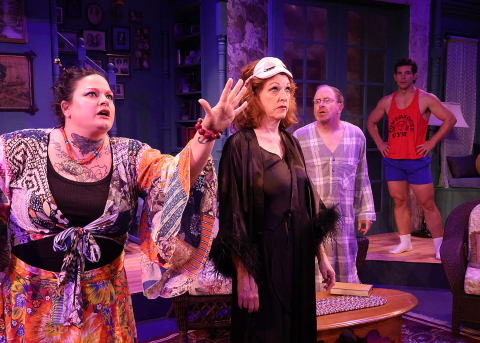
What happens when two testosterone-fueled college couples and one bookish sister get trapped in a remote log cabin in the woods? Throw in a chubby, foul-mouthed redneck, a babelicious scientist and her nerdy boyfriend, a talking moose head, a severed hand, a chainsaw, an ax, and a Spinal Tap-sized stone bridge and you have the campy, schlocky, silly, and utterly gross-out Off-Broadway gore-fest fun of Evil Dead – The Musical.
Part Rocky Horror, part Little Shop of Horrors, this zombie slasher flick turned musical comedy is based on Sam Raimi’s ’80s horror films, and it’s a show you can treat your teenagers to and both leave with smiles on your face and splattered stage blood on your shirts.
Sarah Ruhl’s The Clean House is her first major production in New York City, even though she was a runner-up for the 2005 Pulitzer Prize in drama and won a MacArthur Fellowship (otherwise known as the genius award) in 2006. She comes bearing much critical praise, and given that she is only 32 years old, this could prove to be a problem. Will she live up to Charles Isherwood’s effusive claim in his New York Times review that The Clean House is “one of the finest and funniest new plays you’re likely to see in New York this season”?
In a strange way, and despite its apparent experimental techniques, it is a very safe play, just the kind they love at Lincoln Center: pretty, witty, well acted, with nothing too disturbing. And the play has a lot of laughs. But where are the crazy raw edges of life, the truly risky discoveries?
Playing to full houses at the Duke of York’s Theatre in London, Tom Stoppard’s latest play, Rock ‘N’ Roll lays out a theory of art as well as a political story line. Basically the play suggests that art—in this case the music of classic rock ‘n’ roll—thrives on a deeper level in countries that censor it (like those behind the Iron Curtain prior to the fall of Soviet Communism).
Now, this is not a new vision; there was a good deal of talk in the 1970s and ‘80s about how literature, particularly poetry and fiction, held a much more sacred and significant place where it was censored. American poets envied their Russian peers, who lived in a place where a poetry performance might be a major cultural event, where people actually lined up to hear poets read their work and sometimes smuggled banned books across borders for friends.
Anticipation for Sarah Michelson’s DOGS at BAM ran high. Prior to a premiere, the British-born dancer/choreographer is passionately tight-lipped about her work. Shunning press releases and brochure blurbs, Michelson whips up a frenzy of curiosity that few artists enjoy. With a BAM debut added to the mix, a coveted prize for many “downtown” artists, the pre-opening frenzy reached a fever pitch of expectation -- perhaps unfair, perhaps cultivated –- but nearly impossible to fulfill.
The visual elements, designed by Michelson and Parker Lutz, who both danced in the work, were truly breathtaking.
A farce about the State Department in contemporary times could be just what we need, but James Armstrong’s Foggy Bottom only partially hits the spot. The acting is quite fine, and the direction by Rob Urbinati keeps it all moving at a lively pace. The premise is promising: a mid-level employee pretends to be his boss, Pat Simon, Assistant Secretary of State for European and Eurasian Affairs, in order to seduce immigrant women with the promise of green cards. Dan Cordle plays Dick, the lusty bureaucrat, staying after-hours so that he can lure sexy exotic women (all with one accent or another) into the empty office of his boss.
Act one is basically a series of sexual gags, some humorous, but most rather tasteless,
Red Metal Mailbox has created what at first appears to be a delightful confection of 1890s-style all-female vaudeville. Three talented performers dance, sing, pout, tell jokes, do tricks, and generally create the intimate atmosphere of a Parisian nightclub in the basement of an industrial building just on the edge of Long Island City. Standing outside on a warm spring night, one can see the buildings of Manhattan just across the East River. For a jaded Upper Westsider, it’s worth the trip to Queens.
Presented as part of the Chocolate Factory’s Visiting Artists Program, Old Tricks is the creation of Sarah Maxfield, Rachel Tiemann, Sarah Gancher, and Ali Harmer. Red Metal Mailbox’s mission is to create “investigative performance by linking original text with a highly physical aesthetic.”
Is Robert Wilson a genius? The answer, I think, is yes. His latest directorial work, Peer Gynt, a coproduction of the National Theatre of Bergen and the Norwegian Theatre of Oslo at BAM, reveals once again how he can bring alive on stage a mesmerizing visual world, reinvent it, ensnare us in it, and take a long time to let it go. His method succeeds particularly well in this early Ibsen work, a strange folktale-like enactment of one man’s life of fierce and often futile adventure.
Ibsen completed Peer Gynt in 1867, and was pleased with what he saw as a play in verse not meant for the stage; its fantastic elements (scenes with trolls and other mythical
Early in the Spanish Civil War, Federico Garcia Lorca was executed by the Fascists. He was only 38 years old. A great poet was lost. The Lincoln Center production of Bernarda Alba is a reinterpretation of Lorca’s The House of Bernarda Alba, written in 1936 and initially performed shortly after his death. Lorca’s play presents a tyrannical Spanish mother and her five sex-starved daughters in the context of backward village values in traditional Spanish culture. As a boy, Lorca had spent summers in such a village, watching the chaperoned and cloistered local females from a distance.
While he was working on the play, it was described in a newspaper as a “drama of Andalusian sexuality,” and Lorca noted, at the front of his manuscript copy, that the work should resemble “a photographic document.”