
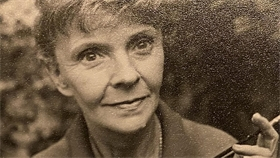
By the time of her death in November 1999, aged 87, the novelist Kathleen Farrell was pretty much forgotten, and she knew it. Despite penning five witty and elegant novels, by the mid-sixties, all of them were out of print. She was the victim of a sea-change in literary taste. First came the wave of angry young men in the late fifties, and then the dominance of pop culture in the next decade, which rendered her yesterday's news. She ruefully admitted she'd no idea why she'd bothered leaving her copyrights to anyone since her books would never be of interest again.
A handful of short stories appeared in respected anthologies where she rubbed shoulders with the likes of Graham Swift and Salman Rushdie; these kept her name in circulation into the eighties, but being of independent means, she never needed to earn money from her craft. It is no coincidence that her last novel coincided with the ending of her twenty tumultuous years in Hampstead with the mercurial writer Kay Dick, after which she largely fell silent, and Kay didn't publish a new work for over a decade. The pair had been catalysts for each other, and though no longer an item, lived nearby for the remainder of their days in Hove, phoning daily, bickering occasionally, but never quite solo entities. In a fit of pique after a particularly acrimonious row, Kathleen burned her entire correspondence from Kay, a sad loss as they'd known everyone. George Orwell, Angus Wilson, Stevie Smith, and Ivy Compton Burnett, to name but four. So many beguiling literary snippets were reduced to ash.

In 2024 after years of dropping her forgotten name, I managed to interest Faber and Faber in republishing Mistletoe Malice. Farrell's debut novel which skewered a dysfunctional family Christmas reunion. It garnered rave reviews in The Times and The Guardian, sold seven thousand copies, and remains in print. It was simultaneously translated into Italian and, last year, appeared in French as Un Noël Chez Tante Rachel. Such a luxury was never afforded her in her day, bar a few American print runs. Now Penguin has dusted down her third novel, The Cost of Living, with an astute introduction by the novelist Jane Fallon. The novel is a brittle study of two bedsit-dwelling women, a young artist, Alexandra, who spends her days doing portraits of dogs and unappealing children, and Marianne, a woman in her thirties who types dreadful novels for authors that are unlikely to ever see the light of print.
"By the time I nearly finished the novel, it seemed to get longer and longer towards the end, and sadder too, and much sillier. There was only one woman in it, and she spent most of her time retching and clinging to park railings, and when she wasn't doing that, she was leaning her forehead against the wall in some dark alleyway. Leaning her forehead against the wall was to stop her from being completely overcome by nausea. I can't remember it ever doing that. I wondered how such young men managed to make women feel so sick, so often. And I thought poor young men, how they suffer."
The ladies plan a party to meet men, but it turns out that the mixture of personalities who appear, they could likely have lived better without. There's Donald, a bus conductor with literary aspirations, a bespectacled and twitchy Bernhardt, and a ghostwriter named Marius. A few nondescript Peters add to their number as do the gatecrashers, a glamorously sexy girl called Pisa, and a middle-aged, but loud Mummy. This wasn't quite the plan, but it suggests why Farrell opted for such an apt title for her annotation of the proceedings. It is all rather a waste of the women's meager supply of cheap booze. There's meeting people, and meeting the right kind of people, and then there's the aftermath. It is a near-perfect dissection of female friendship, the listlessness of souls, and a glimpse into the lives of women prior to the pill and the liberation movement.
In Farrell's clipped, precise prose lie echoes of Muriel Spark and Barbara Pym. Her style is one of mannered elegance with an edge of arch cynicism.
She once remarked, "A happy marriage is all very well, but it can be rather boring for a whole evening." Kathleen used to play chess with Quentin Crisp and was friends with Barry Humphries, who'd attempted to assist me in getting her republished years ago, but to no avail. She'd be shocked and privately pleased to see such a positive reappraisal of her talents, and the eye-watering prices her first editions now command. At her request, I was given her sole copy of Mistletoe Malice after her death. It became the one Faber utilized for its republication. A wonderfully circuitous completion.
There are future plans for her remaining three books, and hopes that her short stories may be gathered into a single volume. They certainly deserve to be. Kathleen Farrell was a petite and perfectly attired figure, her lack of stature adequately compensated for by a steeliness of soul and her fierce intelligence. Her work retains a profound relevance because she knew what motivated people, even if she was wide of the mark about how her own novels would be remembered.
I adored getting letters and postcards from her. They were often prefaced with words like "Tuesday. I think." She belonged to a world that has now gone. To have caught her somewhere towards the end was both a pleasure and a privilege, and her return to print was a rare reward.